|
|
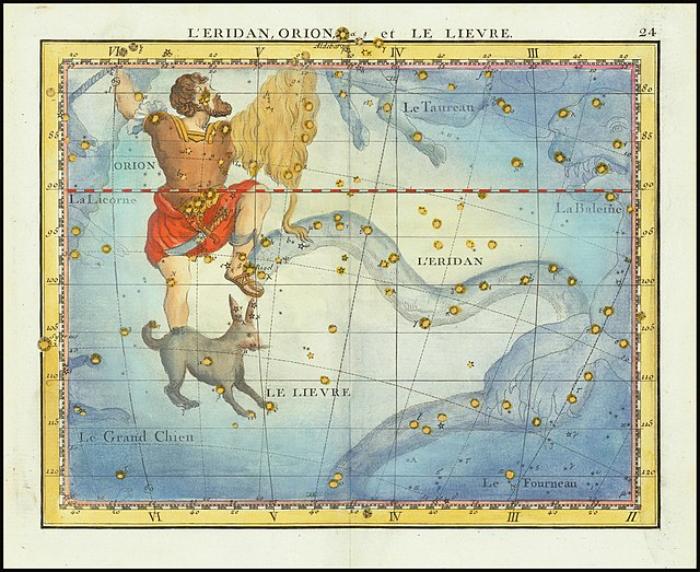
Like many, as a kid, I used to make a mix of various fruit juices, which often wound up a somewhat suspect-looking colour, that I called "beetlejuice"-- a pun on a prominent star pronounced in the same way: Betelgeuse. The name refers to a star in the constellation Orion where it marks "the shoulder of the giant" (which is the literal translation of the Arabic phrase "bat al-jawzā" which means “the giant's shoulder” from which the name Betelgeuse is derived-- as it appears at that position in the constellation which we know as Orion, the hunter). Betelgeuse is what astronomers call a semi-regular variable star, meaning its brightness changes over time. Between 2019 and 2020, it dramatically dimmed to about 40% of its normal brightness, sparking speculation that it might be about to explode. The dimming was likely caused by a massive dust cloud ejected from the star's surface as it is constantly shedding mass through powerful stellar winds, losing material equivalent to one Earth mass every six years. This creates a vast envelope of gas and dust around the star, making it appear fuzzy when viewed through powerful telescopes.
|
 |
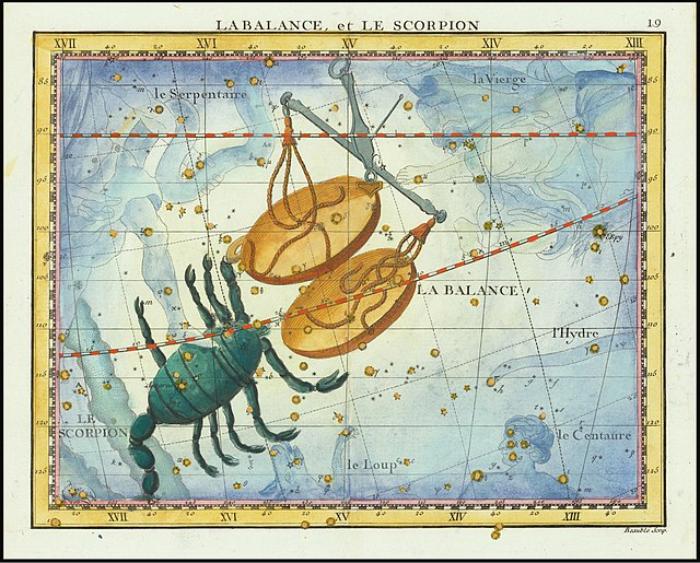 |
Although the star Betelgeuse has nothing to do with insects, the constellation Orion, in which it appears, isconnected with the constellation Scorpio, which does, at least, represent an arthropod, if not an insect. In Greek myth, Orion boasted that he could kill any creature on Earth. Artemis, the huntress goddess, sent a massive scorpion to humble the arrogant hunter. The battle ended with both creatures' deaths, and they were placed in the sky as a reminder of hubris— deliberately positioned so they never appear together, with Scorpius rising as Orion sets. The ancient Persians believed that Scorpio was the emissary of evil sent to destroy life by attacking the sacred bull (Taurus, which is located close to Orion). These stories reflect the ancient understanding of seasonal star visibility and demonstrate how mythology served as both entertainment and astronomical calendar. |
Orion served as a celestial calendar for ancient civilizations. Its rising marked the beginning of winter in the Northern Hemisphere, while its setting coincided with summer's approach. Ancient Egyptians associated Orion's heliacal rising (first appearance before dawn) with the flooding of the Nile River. Although designated "Beta Orionis," Rigel is actually brighter than "Alpha Orionis" (Betelgeuse) most of the time. This naming inconsistency occurred because Betelgeuse was brighter when the constellation was first catalogued, demonstrating how variable stars can confuse even careful astronomers. Within the Orion Nebula lies the Trapezium Cluster, a tight group of hot, young stars whose intense radiation illuminates the surrounding nebula. These stars are less than a million years old—practically newborns in cosmic terms.
|
 |
|
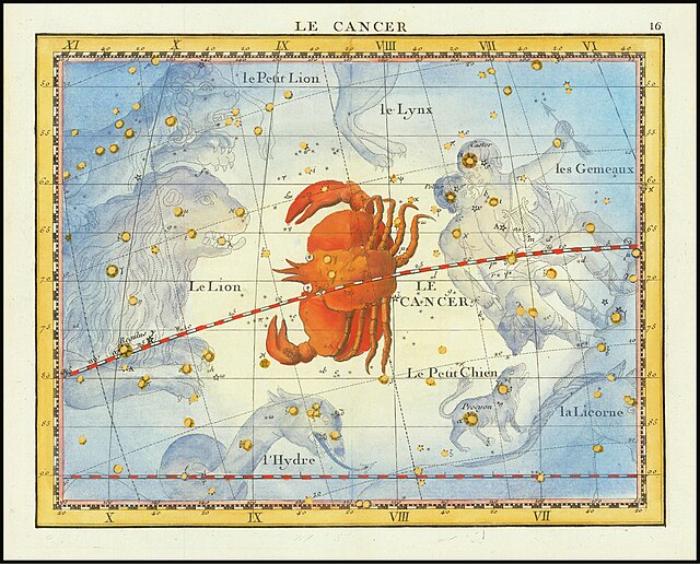
Cancer, like Scorpio, is another arthropod constellation occurring in the zodiac (constellations that lie in the plane of the ecliptic) and a number of other constellations are associated with arthropods. According to Greek myth, Cancer was immortalized as a constellation after the crab, sent by the goddess Hera to distract Hercules during his battle with the monster Hydra, was crushed underfoot by the hero. Despite this mythological heritage, Cancer remains one of the faintest zodiacal constellations, leading some astronomers to joke that even the gods seemed unimpressed by the crab's brief heroic moment. |
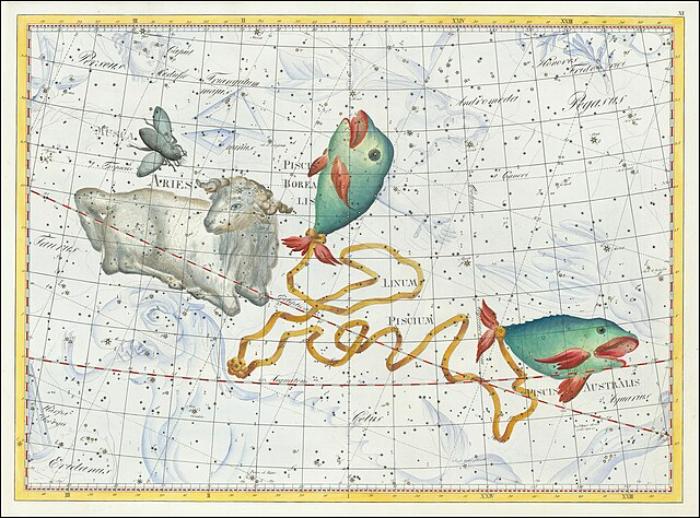
In the past, the constellation Apis, the bee, was recognized as worthy of its own designation, close to Taurus. Apis was mapped in 1612 by Dutch astronomer Petrus Plancius, who originally called it "Apes" (plural of Apis, meaning "bee" in Latin). This may have resulted, in part, from Plancius confusing references in ancient texts associating Taurus with Apis. Apis was the Egyptian name for the sacred bull deity worshipped in Memphis. |
 |
|
Iin the 17th century the same asterism called Apis, by Plancius, was mapped as Musca Borealis, the Northern Fly. But this asterism was abandoned, and its stars—33, 35, 39, and 41 Arietis—were fully integrated into Aries. |
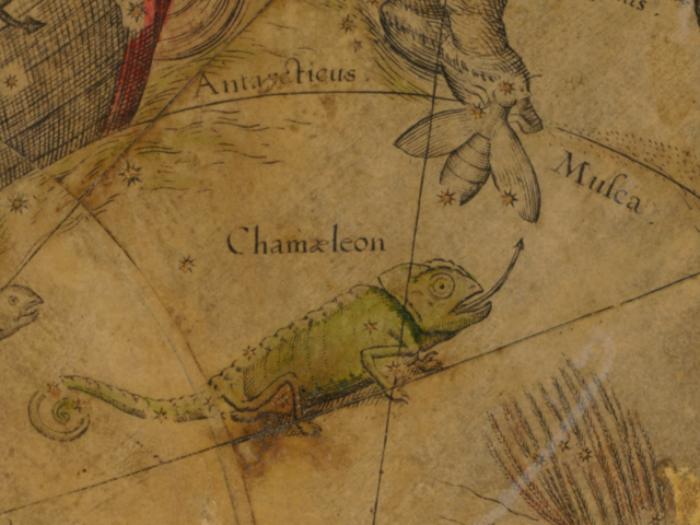
However, the southern counterpart, now simply called Musca, remains an officially recognized constellation and was first charted in the southern skies by the Dutchmen Pietr Dirkz Keyser and Frederic de Houtman between the years 1595-1597 |
 |
 |
Of course, the above constellations are only those traditionally recognized in western traditions-- other cultures had their own versions. For instance, the Blackfoot Indians envisioned the stars of the Corona Borealis as the Spider Grandmother whose great web covered much of the night sky. |
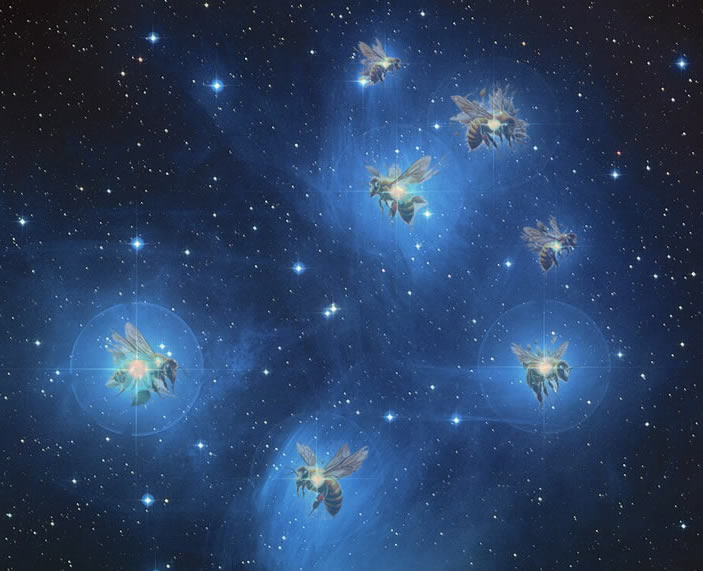
Very close to the area of the sky where the constellation Taurus can be found are the Pleiades . This distinct cluster of six stars (seven to the sharp-eyed) was perceived by the Chiriguana people of South America as a swarm of bees, and their appearance in the night sky was an important calendar mark which indicated that honey harvesting time was at hand. |
 |
|
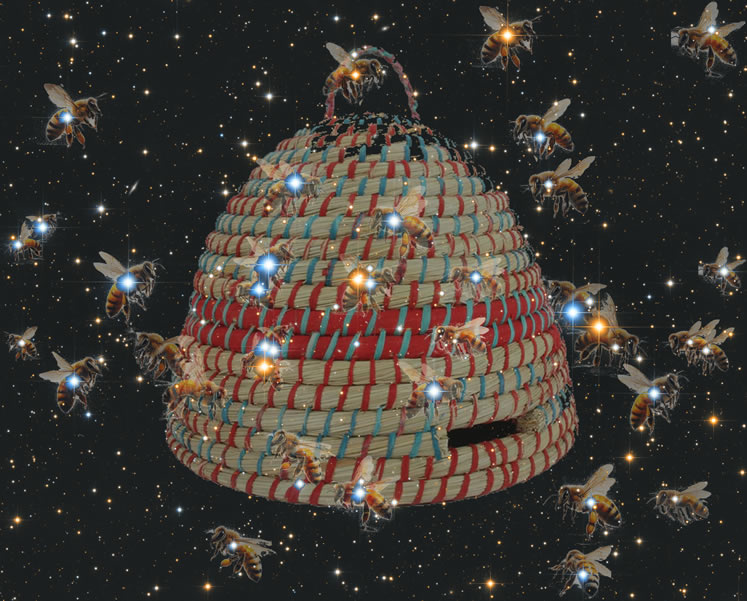
The star cluster Praesepe, which lies in the center of the constellation Cancer, is also known as `the Beehive' (apparently because of its resemblance to a swarm of bees) although this appears to be a relatively recent moniker and there are no myths (that I could find) connecting it with bees. |
As indicated by their appearance in ancient myths and the calendar/constellation signs to which the myths often refer, arthropods had a profound effect on life in predominantly agrarian cultures, particularly as dangerous pests: scorpions and poisonous spiders-- or as pests and plagues. Many arthropods remain important sources of food-- but never, as far as I know, for beetle juice. |
|
| |
|